

The Zeitgeist: Museums Are Making A Case For Luxury Fashion
ANGELA WEISS
A dressed body tells a story, just as an exhibition in a museum does. For eighty years, dress has largely been relegated to its own separate art form, and the link between fashion and art has been less apparent than one might think; this is beginning to change.
Situated at the corner of Fifth Avenue, The Frick Collection reopened on April 17, 2025, after a five-year, $330 million comprehensive renovation. The new construction increased the Gilded Age museum and library's permanent collection and exhibition gallery space by 30%, adding 27,000 new square feet to the existing 60,000. Since then, it's been a hotspot for tourists and locals alike to enjoy an extensive collection of Old Master paintings, European sculpture, and decorative arts. An average adult ticket is thirty dollars, but the Frick recently announced that, thanks to Louis Vuitton's three-year investment in the museum, visitors can enjoy free admission on the first Friday of every month until May 2027.
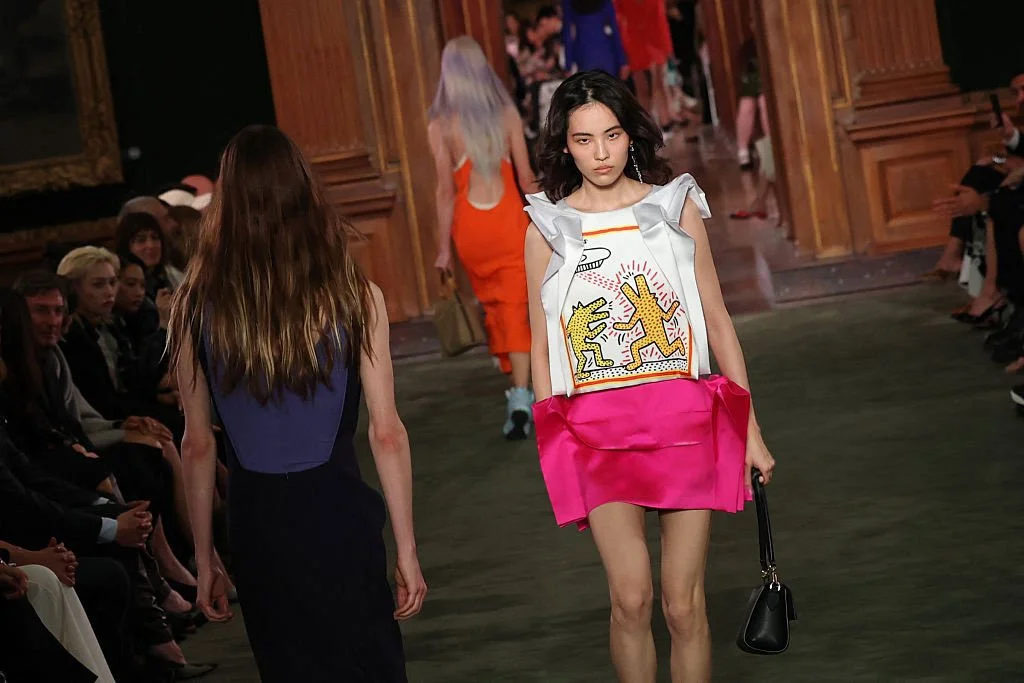
"Louis Vuitton First Fridays" was then immediately followed by Louis Vuitton's 2027 Cruise Show, where the luxury label showcased bright, saturated color palettes and zany, Keith Haring–inspired illustrations that explored the sartorial cultural exchange between New York and Paris.
The choice of venue was no accident. Fashion shows at historical institutions are not new. This might have been the first time the Frick hosted a fashion runway show in its first-floor galleries, but powerhouse luxury houses often choose historical venues, a palazzo, for instance, to exhibit their collections.
In an age where the high-profile sponsors of arts culture are typically financial sector magnates like Bloomberg or J.P. Morgan, a heritage institutional partnership with a luxury fashion house feels like an anomaly. Louis Vuitton's continual investment in The Frick signaled something different.
Broader pattern of cultural engagement by luxury brands
Louis Vuitton's partnership with The Frick is the latest chapter in a much older story: wealthy, powerful families bankrolling art and culture. The Medici were bankers who sponsored Renaissance painters; today's equivalents are luxury houses, many of them still family businesses in practice if not in ownership, where leadership passes down a bloodline the way it did for the Medici themselves. Prada is a clear example of that lineage. In 1993, Miuccia Prada and her husband Patrizio Bertelli founded Fondazione Prada, and through it, turned a leather goods company into something closer to a cultural engine. The Fondazione backs emerging, avant-garde artists and treats art not as a branding exercise but as a genuine platform, one that pairs artistic vision with ambitious, site-specific work in art, architecture, and film. Prada Mode, an annual collaboration between the brand and artists to build immersive experiences for loyal customers, and Miu Miu's literary club "Writing Life," a multi-day symposium for writers and intellectuals, both grew out of that same instinct.
LVMH operates at a different scale but follows a similar logic. Bernard Arnault, the conglomerate's chairman, is one of the world's most prolific art buyers, and his interest in art reads as both personal and philanthropic. LVMH has donated tens of millions of euros toward museum acquisitions to help France retain national treasures, and its name now sits on European institutions like the Courtauld and Central Saint Martins: the result of corporate philanthropy that has become, over time, closer to a core business strategy than a side project.
Smaller, newer initiatives are following the same playbook. The Chanel Culture Fund, which supports "a global programme of cultural innovation," recently backed Frank Wang Yefeng's Groundless Flower, a surreal film that blurs the line between the human and the digital and screened on New York's High Line Channel. LOEWE's Craft Prize and the Fondation d'entreprise Hermès work in the same territory: brands commissioning artists and cultural leaders, and in doing so, buying themselves a seat in the global conversation on art and culture.
The Met: "Fashion is Art"
Fashion innovates faster than almost any other art form, as it touches everyone: everyone wears clothes. Museums, in turn, are among the few remaining public sites for encountering history directly. Put those two things together, and the appeal of a fashion-museum partnership becomes less about marketing and more about access: anyone can walk into a museum, and increasingly, that museum is telling fashion's story alongside art's.
As The Metropolitan Museum of Art's Costume Institute director Andrew Bolton aptly put it, "the history of art cannot be told without the history of dress." That idea shaped this past year's Met Gala theme, "Fashion is Art." Where earlier galas tended to spotlight a single era or designer (such as Karl Lagerfeld, Alexander McQueen) this one made the pairing explicit, arguing that fashion belongs in the same category as painting or sculpture, not adjacent to it.
That argument has a longer history than the exhibition lets on. For decades, critics justified calling fashion "art" by stripping it of its practical purpose and its relationship to the body, treating it instead as pure textile value: embroidery, beading, construction. Designers pushed back against that framing directly. Marc Jacobs did it at Louis Vuitton through collaborations with Yayoi Kusama and Takashi Murakami, and Elsa Schiaparelli did it decades earlier with her surrealist "lobster dress," made in direct dialogue with Salvador Dalí.
The Met Gala itself has become inseparable from that argument's success. The New York Times described the partnership as "the gateway to the museum," and despite negative press around this year's primary sponsors, the gala reportedly raised $42 million for the Costume Institute, the largest single fundraising total in its history. It is hard to separate that figure from the Met's broader position as arguably the most important cultural institution in the country: an institution that lends fashion legitimacy by hosting it.
Evolving Brands, Evolving Institutions
For luxury brands, aligning with legacy cultural institutions is a strategic move as much as a philanthropic one. It raises visibility for both sides and lends the brand a strand of cultural prestige that advertising alone cannot buy, while giving the institution a way to argue it is still relevant to a digital-first public. The arrangement provides brands like Louis Vuitton with real creative input, such as commissioning artists and shaping programming. And it meets consumers where they increasingly are: prioritizing experience over acquisition, which makes an immersive museum partnership a better bet than another product launch.
The Frick's renovation captures that shift in miniature. Louis Vuitton's investment funded not just a physical expansion but, by extension, an institutional one. The museum's post-renovation programming looks more ambitious and more public-facing than before. The Frick describes itself as a research center for students and scholars as much as a public gallery, and that dual identity, along withLouis Vuitton’s partnership, speaks to scholarly credibility and increases mass visibility.
The Bottom Line
What's changed isn't that luxury brands fund culture, but who is behind the funding of culture today. Today’s fashion houses are commissioning and exhibiting a discipline they do practice, which means the line between patron and subject has all but disappeared. Louis Vuitton isn't just paying for access to the Frick's walls; it is paying so that everyone can have more access to art and fashion.
