

Resilience: Breaking out of the echo chamber

Robert So
Open your favorite social media application and keep scrolling for a couple of minutes. You will likely see various posts that align with your beliefs. You will see one nutrition video, and suddenly your feed will be filled with health tips.You will 'like' one travel video, and soon enough your timeline will be filled with travel recommendations. In a matter of time, you become convinced that everyone shares your views and opinions.
That feeling can often be an illusion.
Behind every swipe, click, and like are recommendation algorithms carefully designed to keep us engaged. These algorithms continuously learn what captures our attention and recommend similar content to keep us engaged. This way, we receive a personalized online experience that is convenient, engaging, and unique. However, there is a downside: if our feeds consist only of like-minded content, we might miss opportunities to encounter different points of view that could challenge our beliefs.
The phenomenon is referred to as an echo chamber, defined as a place where people communicate with others who share similar opinions, views, and experiences. Hence, in these online spaces, ideas are repeated, validated, and strengthened to the point that they seem to be widely acknowledged truths. Eventually, it appears natural to think that one’s own opinion is the only rational one merely because the person has been exposed to it constantly.
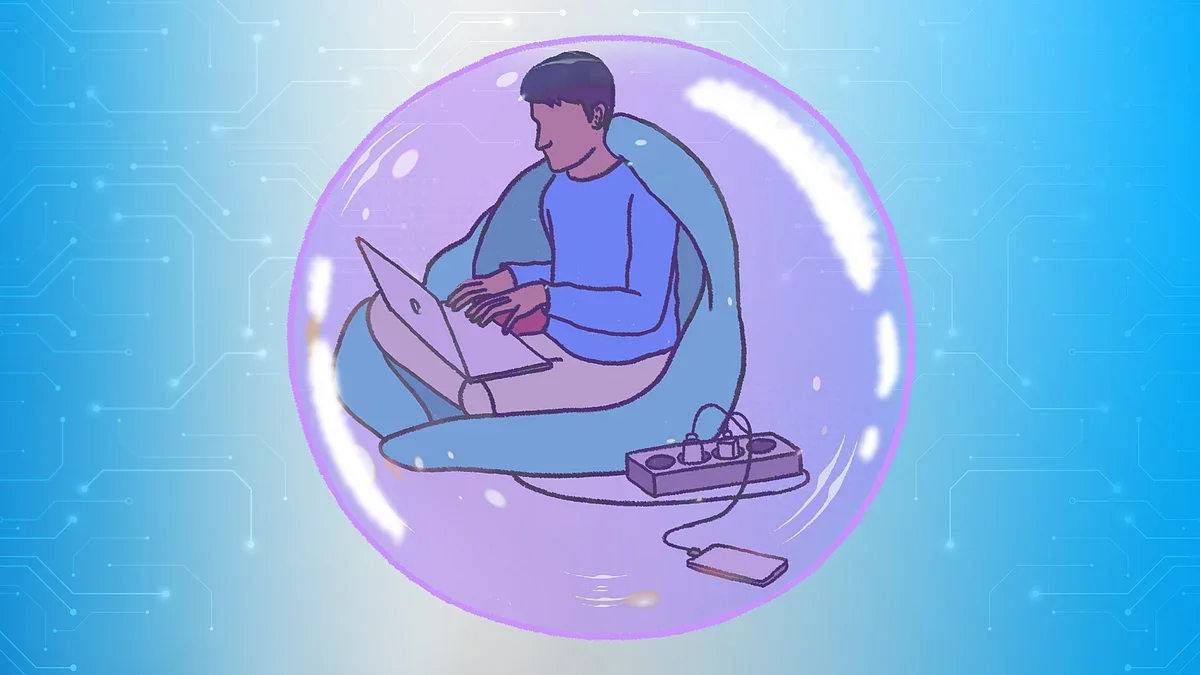
Illustration of a person inside a digital echo chambeR
This pattern is supported by research published in the Proceedings of the National Academy of Sciences (PNAS). The study analyzed more than 100 million posts across popular online platforms such as Facebook, Reddit, Twitter, and Gab and found that users tend to join communities with individuals who share their views. Thus, these platforms fail to expose users to different information and instead reinforce their existing beliefs.
These echo chambers are not entirely negative. Connection with groups that share our views can help us get support and give us a sense of belonging and safety, where we feel understood. For anyone with rare interests or a stigmatized identity, this can be hugely empowering.
The challenge begins when comfort turns into isolation.
Without exposure to different perspectives, people are less likely to question their assumptions or broaden their understanding of others. When people stop thinking of their disagreements as opportunities to learn, they view them as threats.
Interestingly, research in psychology suggests that this may not be merely a technological phenomenon but rather something inherent in human nature.
People naturally seek consistency between what they believe and the information they encounter. When people encounter information that supports their beliefs, they feel reassured. However, when they encounter views that contradict their beliefs, they experience cognitive dissonance, making it hard to accept them even when those views are logically sound.
Leon Festinger was the first psychologist to introduce cognitive dissonance theory back in 1957. According to him, people always strive to remain consistent internally. Information that contradicts one’s deeply ingrained belief systems and changes one's decisions leads to psychological discomfort. The natural response to the feeling of dissonance is not only to reject information; it also leads people to form communities where they reinforce their beliefs and avoid questioning them.
As a consequence, we think we are having conversations with people who think as we do, but we are really trying to avoid difficult ones. In scientific terms, this phenomenon is referred to as homophily: the tendency to connect with individuals who think like us, share similar backgrounds, and hold similar values. The use of social media algorithms has intensified this tendency because they show us content we have previously liked, seen, or shared. Technology, therefore, does not cause bias but reinforces it.
The psychology of humans, as well as algorithms, limits our access to a variety of opinions. Even when we believe our attempts to gain some important information by expanding our areas of interest are successful, in reality, we are being limited by the virtual world–a problem that does not concern only social media.
By communicating mostly with people who share our opinions, we risk losing our critical thinking skills. The phenomenon occurs when people do not doubt their opinions. In addition, simple problems become even simpler, thus making it more complicated to resolve conflicts. Instead of wondering what one can learn from an opinion, we are looking for ways to prove the opponent wrong.
By recognizing both the benefits and the limitations of our personalized digital environments, we can begin to move beyond the echo chamber, not by rejecting technology, but by becoming more intentional in how we engage with the people and ideas around us.
But becoming more intentional is only the beginning.
It should be noted that leaving your comfort zone means much more than just getting messages on your timelines. Regularly engaging with people who hold different opinions strengthens our ability to evaluate our own beliefs rather than simply defend them. Respectful disagreement can challenge our assumptions, reduce cognitive bias, improve problem-solving, and strengthen both our personal and professional relationships. In other words, being able to disagree with each other is proof of the power of our beliefs, as it shows we understand why we think that way.
Fortunately, broadening our perspectives does not require abandoning our values. It can mean only starting to adopt small habits: following the opinions of people with different mindsets, reading news from various sources, choosing books written by authors of different cultural ancestry, having civilized discussions with people who have different life experiences, and taking time to reflect on our own assumptions. The goal is not to agree with everything you learn but to discover why people think differently from you.
Furthermore, one might say that openness leads to another crucial skill: emotional resilience. In order to understand someone whose opinions differ from yours, you need to have patience, curiosity, and empathy, which are key to finding common ground in today’s world of tough debates and discussions.
We cannot control every algorithm that shapes our feeds, but we can control how we respond to what we see. Choosing to engage with different perspectives does not require abandoning our values. Instead, it requires the confidence to examine them. In an era increasingly defined by personalization, our greatest strength may not be finding more people who agree with us, but remaining open to those who do not.
