

Dining Houses: Eating Alone Together
Mikhail Nilov
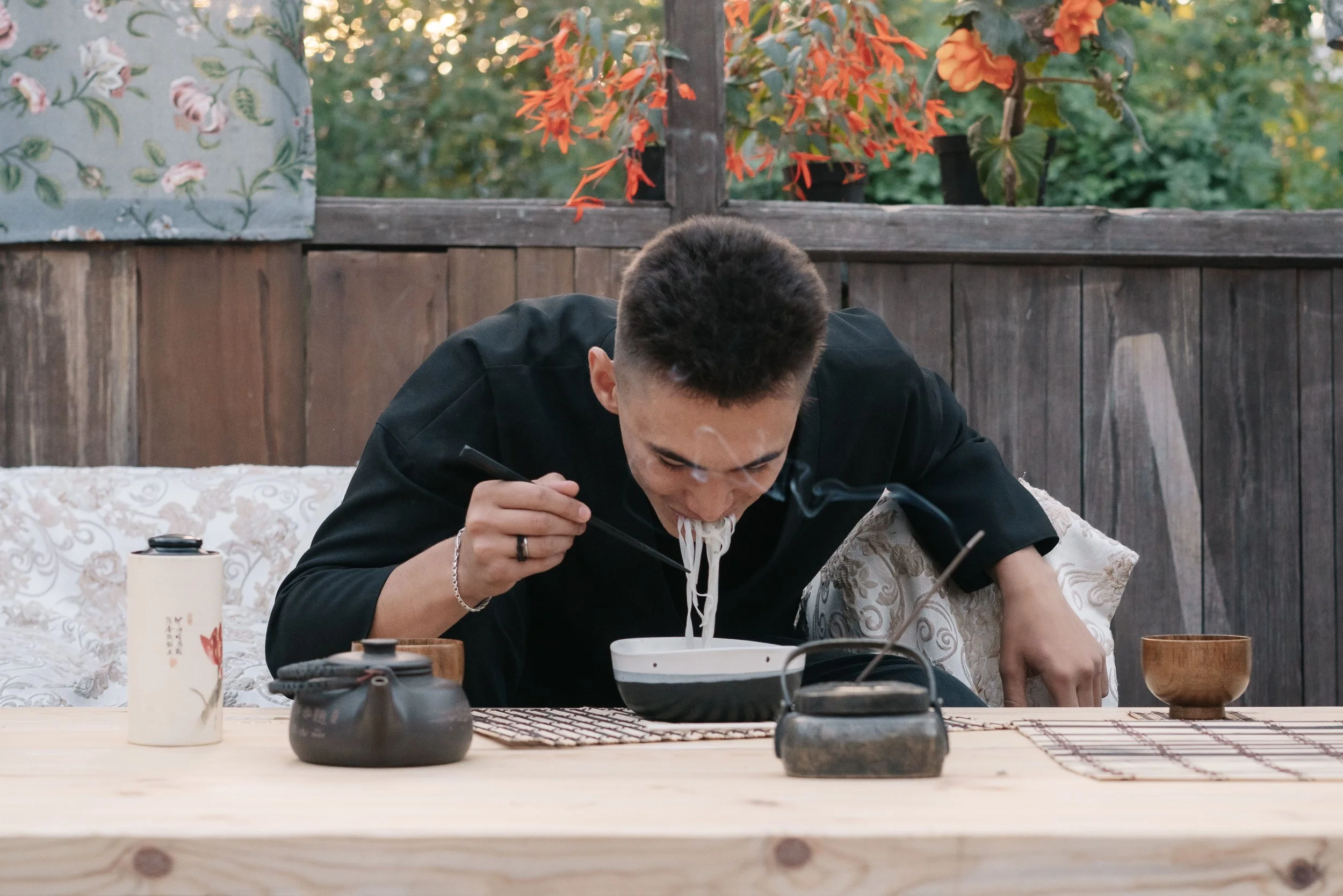
Introverts always know where to look when they are outside. It is assumed that appearing amongst crowds of people is a game of survival to avoid daggers of eye contact and human interaction. Through years of experience, they have successfully conquered several territories: enclosed desks at the library, corner window seats at In-N-Out that are safely out of the traffic of people lining up for their orders, and the last booth at a diner. And then, they discovered the holy grail of Ichiran, where an entire restaurant is designed around the radical idea that someone might actually want to enjoy a bowl of ramen in peace.
Most introverts, or people in general, are not actually hiding from society. For a long time, restaurants seemed to be built exclusively for couples, families, and celebrations, making solo diners feel as though they were occupying a seat meant for someone else. That assumption is beginning to change. As more people dine alone because of a growing comfort with their own company, restaurants are discovering that designing for one person is no longer a niche accommodation.
The increase in solo dining reveals several overlapping societal changes. Remote and hybrid work have untethered many people from traditional office schedules, making lunch more of an ad break between meetings. Business travelers continue to fill hotel restaurants, but now they are joined by solo travelers, digital nomads carrying laptops, and freelance writers on the brink of extinction seeking an afternoon workspace. Younger generations also appear less constrained by the fear of appearing alone in public. A solo reservation “gives” independence rather than social incompetence. Perhaps the months of isolation during COVID-19 taught many people how to enjoy their own company while simultaneously increasing appreciation for public spaces that provide a sense of connection without demanding conversation. Or perhaps the working day is just so painfully dragging that no one has energy to care about looking pretty while wolfing down a burger at night.
For restaurants, accommodating solo diners is not a simple “table for one.” Traditional dining rooms often let slip how thoroughly restaurant design assumes that every customer arrives as part of a pair or a group. A four-top occupied by one is inefficient from a business perspective, but squeezing that same guest into an undesirable corner subtly hints that they matter less. Some places have begun rethinking this by introducing communal counters, chef's tables, window bars, and flexible seating.
Japanese ramen shops are the pioneers. Chains such as Ichiran are famous for individual dining booths separated by wooden partitions, where diners order through a form and receive their ramen through a small curtained opening with little more than a brief exchange. High Five Ramen in Chicago has just a handful of intimate booth seats, with dim lighting and a compact basement dining room to make shoyu flavors stand out more than the diners. While part of the concept is rooted in aspects of Japanese culture that value efficiency, reservation and personal space, its appeal extends much further. These places understand that when there is a lot on someone’s plate, they need to focus on what is in front of them and not how to have a conversation.
Hotpots, which are not traditionally eaten alone, are adapting fast. Zhangliang Malatang, a student favorite in Champaign, makes hotpot single-serving: customers pick ingredients by weight, then everything is cooked together in one personal bowl of broth. Ban Mi Wu Tai (半米屋台) in Chengdu, China replicates the Ichiran experience by seating each diner in a semi-enclosed booth with an individual burner and personal pot of broth. No judgment for ordering five plates of marinated ribeye or premium beef tongue. Barbecue places are catching up as well. In Japan and Singapore, Yakiniku Like offers “self-grill BBQ experience” by giving each diner a private grill, rice, portioned meat set, and a “fuss-free” time.
Many Western attempts have embraced the opposite philosophy by making solo diners feel connected to the activity around them. There is always something happening in Trust in San Diego. Counter seating overlooking the open kitchen replaces blank stares and awkward waiting with chefs slicing fish, swirling butter in pans, and plating braised oxtail raviolini. Seattle’s Single Shot’s long marble bar is not a secondary seating option for those unable to get a table. A solo diner can settle into a stool with a cocktail and roasted chicken, watch bartenders shake drinks, and overhear fragments of neighboring conversations without feeling obliged to join them.
The experience resembles sitting at the bar during a baseball game. Conversation is optional because there is always somewhere for your attention to land. At I Cavallini Brooklyn, the same idea is extended through thoughtful menus that invite slower observation. At the solo walk-in bar, a solo diner can linger over spicy bluefin tuna topped with data butter, and have a personal debate over whether the sweetness balances the saltiness before moving on to handmade pasta and a glass of wine.Solitude does not necessarily mandate privacy, because sometimes people just want to feel present without becoming the center of attention.
Of course, not every attempt to embrace solo dining succeeds. Fine dining is frequently the source of such controversies. Michelin-starred tasting counters, such as ten-seat kaiseki restaurant Muku, intentionally place solo diners directly in front of the chef and offer an unobstructed view of every garnish and flourish. In theory, it’s the highest form of personalized hospitality, but in practice the experience is still performative. The parade of tiny, meticulously plated courses demands as much attention as a museum exhibit, while neighboring diners debating the provenance of each ingredient can replace one form of social pressure with another. Solitude, after all, is not necessarily the absence of people but the absence of expectation.
Nor does every culture embrace solo dining in the same way. In Paris, lingering alone over steak frites and a novel at a sidewalk bistro hardly attracts a second glance. In Spain, tapas bars have long welcomed patrons who stop by the counter for a few small plates before continuing their evening, while Italy's espresso bars normalize standing alone with a coffee before work. These traditions developed gradually over decades and reflect local customs rather than deliberate attempts to market laid-back alone-ness. Simply recreating a café or installing bar seating cannot erase the self-consciousness that some diners still feel.
That being said, that fear often proves greater than reality. There is no limelight on that empty seat or a non-existent companion for the night. No one notices. Instead, servers may greet regulars by name, and cooks may communicate through quick nods during the dinner rush.
The economics of solo dining may also challenge doubts about profitability. Solo diners often eat at off-peak hours, helping restaurants smooth demand throughout the day. They frequently order premium dishes or multiple courses because they are spending only on themselves. Many become loyal regulars, returning weekly or even several times a week as part of their routines. Restaurants have always served as social spaces where communities gather, yet community does not require every person to bring hordes of other people.
Designing for solo diners improves the restaurant for everyone else. Smaller, more flexible tables make dining rooms easier to navigate and reduce wasted space. Better lighting intended to help someone comfortably read a menu also benefits families with children and older guests. Counter seating offers an inviting option for individuals while increasing flexibility for restaurants during busy service. Menus with half portions or smaller plates reduce food waste and encourage diners to explore more of the menu regardless of party size.
As solo dining becomes increasingly common, the restaurants that thrive will not be those that treat eating alone as a novelty. They will be the ones that make a table for one feel as ordinary, comfortable, and welcome as a table for four.
