

Culinary Codex: How Food Should be Held
Jay court
Among more than five million Subreddits dedicated to every conceivable niche, r/WeWantPlates has chosen an unusually specific enemy: the modern restaurant’s tendency to serve food on anything except a plate. Its members keep a humorous catalog of dining absurdities, from burgers balanced on wooden planks to cocktails poured into light bulbs. Their question is simple: why am I eating off this?
At first glance, the complaint appears to concern only presentation. Yet many diners express a similar unease and need to self-defend when food requires direct contact rather than utensils. When Erling Haaland posted a video of himself eating ribs with his girlfriend, he felt compelled to clarify “for the camera” that they “eat with [their] hands.”
Much of the frustration behind r/WeWantPlates is understandable. Few people want steak on slates or chips in mugs. In many cases, the criticism is really a rejection of restaurants that prioritize novelty over practicality. But dissatisfaction with pretentious presentation should not be mistaken for a rejection of foods that have traditionally been eaten without conventional plates or utensils. In many cuisines, touch is an indispensable part. If anything, the excesses of modern "form-over-function" presentation risk obscuring these traditions by placing them in the same category as restaurant gimmicks.
One of the most visually striking examples is the Filipino kamayan, often celebrated today in the form of a boodle fight. Entire tables are covered in banana leaves and layered with steaming white rice, grilled seafood, garlic shrimp, mangoes, salted eggs, vegetables, and centerpiece proteins such as lechon—whole roasted pig with crisp crackling skin and succulent, juicy meat beneath. The attraction of lechon is in the contrast between the brittle skin and the moist layers of fat and meat beneath it. When eaten by hand, diners can deliberately choose pieces with varying ratios of skin, fat, and meat, feeling the resistance of the skin before hearing it shatter. The golden-brown surface, developed through hours of roasting, signals crispness visually, but the texture is communicated through the fingers before the food reaches the mouth. Diners stand shoulder-to-shoulder to enjoy the communal feast food. Using a knife and fork often fragments these layers and separates components that were intended to be enjoyed together.
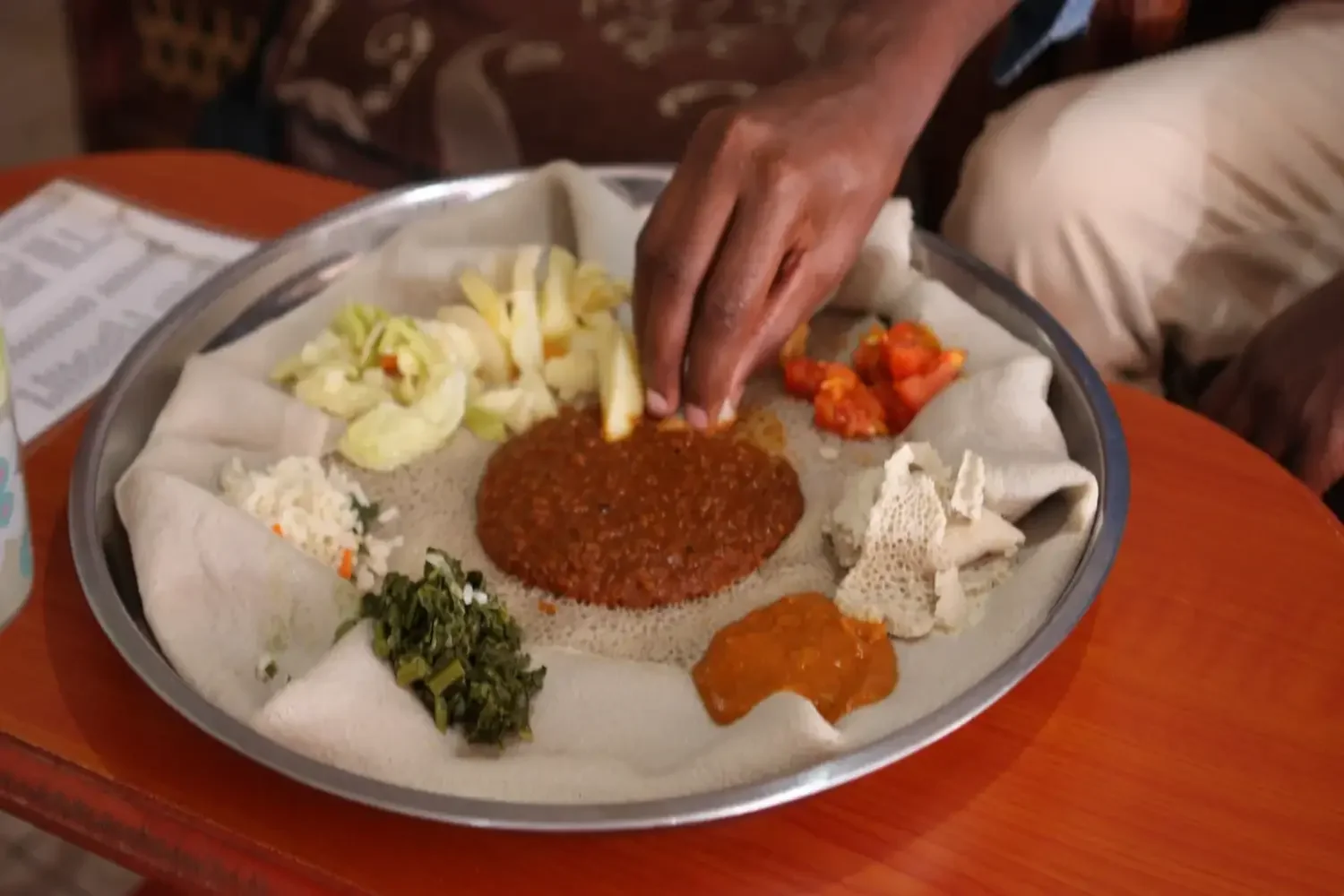
Ethiopian cuisine revolves around injera, a large fermented flatbread made from teff grain. The bread itself serves simultaneously as plate, utensil, and food. Ranging from spicy lentils to rich beef and chicken dishes seasoned with berbere spice, colorful wats are arranged directly atop a broad sheet of injera. Diners tear off pieces and use them to scoop up the stews. The porous texture of injera is specifically suited to absorbing strong sauces and juices and earthy vegetables. A fork changes the experience because it separates the bread from its function. Every scoop combines bread and stew in proportions controlled by the diner, and the fingers help gauge how much pressure is needed to grip the food without tearing the bread. Arrayed across the neutral backdrop of injera, the vibrant colors from the stews and toppings also bring the communal edible landscape to life, drawing diners into a collective and participatory experience.
Across West Africa, staples such as fufu, banku, and eba are specifically designed to be eaten by hand. These dough-like starches possess smooth, elastic textures that can be pinched into small portions and dipped into soups rich with peppers, tomatoes, palm oil, fish, or meat. The sensation of rolling the starch between the fingers before dipping it into fragrant soup is part of the meal's rhythm. As part of mansaf, Jordan’s national dish, a massive platter is piled high with rice, lamb, and jameed, a fermented yogurt sauce with tangy richness. Traditionally eaten with the right hand, diners shape portions of rice and lamb into compact balls before lifting them to the mouth. Mansaf is commonly served at weddings, celebrations, and important gatherings where sharing food from a common platter symbolizes unity and respect.
Indonesian bancakan features a mound of steamed rice surrounded by fried fish, grilled chicken, stir-fried vegetables, sambal chili pastes, nutty tempeh, and fragrant herbs. Central to many Hawaiian luaus is kalua pig, slowly roasted in an underground oven until it becomes smoky, tender, and easily pulled apart by hand. Alongside it may be poi, tropical fruits, sweet potatoes, and freshly prepared seafood. While many contemporary luaus catering to tourists provide utensils and individual servings, traditional Hawaiian feasting emphasized eating by hand from a communal spread.
Argentina's asado centers on fire, meat, and conversation. Large cuts of beef, sausages, ribs, and sweetbreads are grilled slowly over open flames. While knives may be used to portion meats, many items are naturally picked up and eaten by hand. People gather around the grill just to encounter wafts of wood smoke and hisses of sizzling fat. A similar spirit animates South Africa’s braai. Boerewors sausage, lamb chops, chicken, and bread are passed around among family and friends. Lighting a fire here fuels the meal, but it also kindles conversation, camaraderie, and a warm sense of belonging.
Beyond culturally specific traditions, many foods, casual or not, continue to be eaten with hands simply because “you have to.” Those who reach for a fork and knife when eating pizza may be met with side-eyes, as their utensils evoke a kind of aristocratic affectation at odds with a food meant to be folded in the hand and enjoyed amid strings of melted cheese. Chicken wings and ribs in hand allow for full engagement with sticky sauces and glazes. For tacos, forks only serve a supporting role to gather fillings that fall away. As some older folks might say, you can’t be Dutch if you have not tilted your head back and eaten a raw herring.
Seafood, which is commonly associated with refinement, also retains its portability. In Louisiana, crawfish, corn, potatoes, sausage, and other ingredients are boiled together in heavily seasoned water and often poured directly onto newspaper-covered tables. The bright red shells, fragrant steam carrying cayenne, garlic, and spice, and the repetitive motions of peeling create a rhythm that slows the meal. Eating crawfish requires work. Diners twist, crack, and peel shells before reaching the sweet meat inside. Using utensils would be impractical and would remove the tactile relationship between effort and reward that defines the dish. Same for oysters. Historically, oysters were often consumed close to the salinity of the sea, their place of harvest. While a small fork may be used to loosen the oyster, the essential act involves lifting the shell itself. Diners see the irregular contours of the shell, the glistening liquor surrounding the oyster, and the subtle color variations ranging from cream to gray and green. Bringing the shell directly to the lips allows the oyster and its liquor to enter the mouth together.
The critics of r/WeWantPlates are not entirely wrong. Some foods genuinely belong on plates, and serving pasta on a shovel often adds little beyond novelty. Yet the opposite mistake is equally easy to make: assuming that plates and utensils are always the more civilized or proper choice. Many foods derive part of their meaning from the ways they are held, shared, peeled, dipped, torn, or eaten by hand. In these cases, removing the tactile element can diminish the experience just as surely as removing a plate from a food that needs one. The question, then, is not whether food should be served on plates or eaten with utensils. Rather, it is whether the form of a meal respects the traditions, practicalities, and sensory experiences that gave rise to it. Sometimes that means reaching for a fork. Sometimes it means reaching with one's hands. Both can be expressions of good dining when they honor the food rather than distract from it.
