

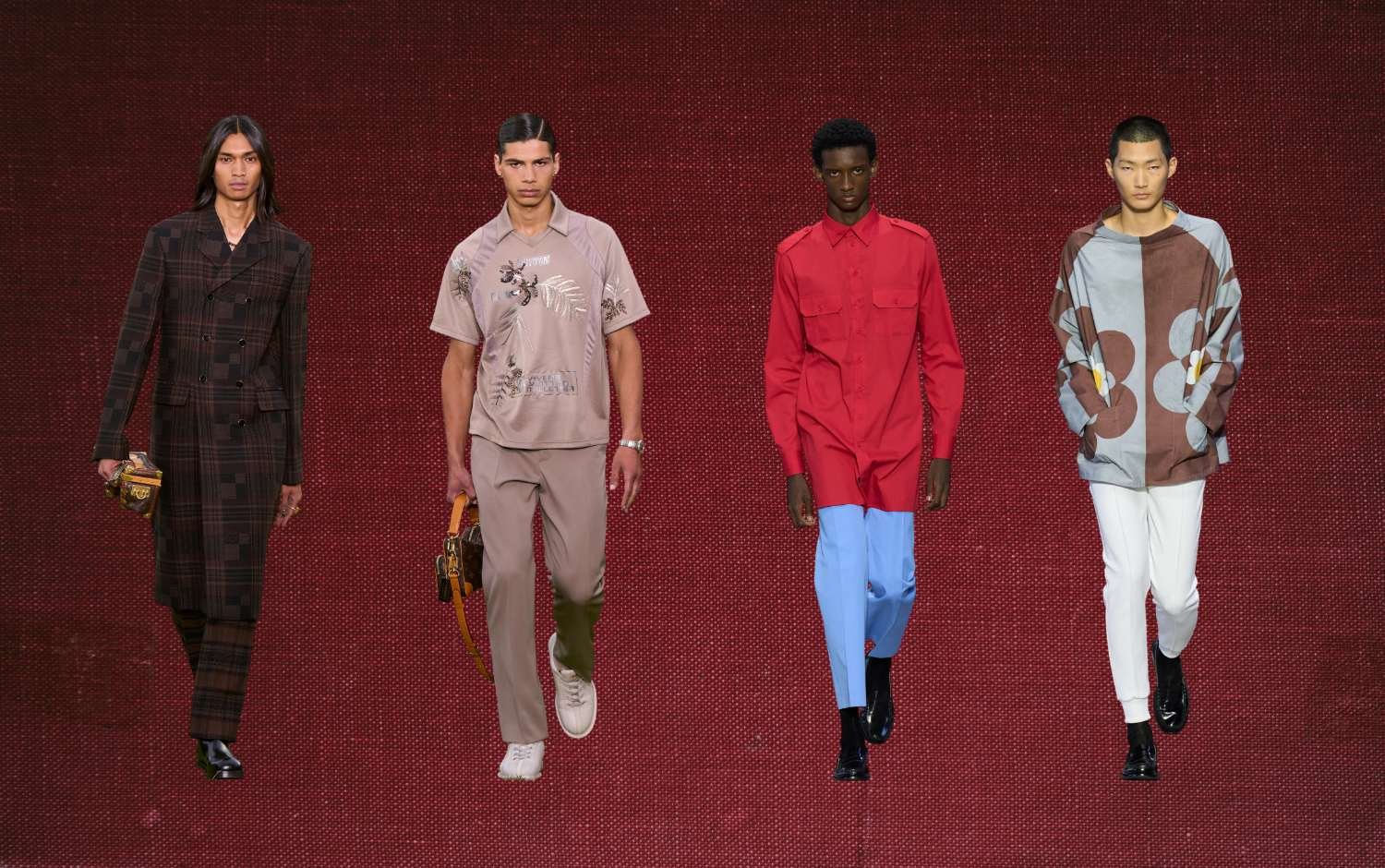
louis VUITTON s/s 2025 and Prada s/s 2026
Menswear today has shifted from a minimalistic approach to an expressive, measured individualism. Conforming to the corporate, monochrome style or the hyper-branded, logo-heavy clothing of streetwear has been sidelined. A philosophy has developed in the fashion industry for menswear that garments should not speak about what you are worth, but about who you are. Who you are is what gives you worth. Jay Bowstead, a lecturer at the University of the Arts London, said that men are no longer buying into a single vision of manliness or success. Instead, men are finding that to be oneself is to follow the logical course of history within our societies.
Where we come from
Menswear fashion is inextricably linked to historical events and their socioeconomic consequences. John Flügel, a British psychologist, coined the term "Great Masculine Renunciation" when trying to explain the sudden cessation of colorful dressing for men at the end of the 18th century. From colorful pomp to dark austerity, the revolutions late in the age of Voltaire resulted in what Flügel sums up as men abandoning “their claim to be considered beautiful.” What they might have been abandoning was, rather, the apparel of an out-of-touch aristocrat, which the French Revolution rendered a capital offense.
Producing masculine, aesthetically pleasing clothing still remained important for those who designed men’s dress. Beau Brummell, a leader of fashion in the Regency period and a close friend of the future King George IV, introduced the tailored dark coat, starched white shirt, and tied cravat that defined the Romantics. As such, the glowing garments worn by those portrayed by Joseph Duplessis, like the Comte d’Angiviller, or Benjamin Franklin—whose face in Duplessis’ likeness is printed on $100 bills—were replaced by the inky long coats seen in Caspar David Friedrich’s Wanderer above the Sea of Fog.
The silhouette became more logical and anatomical. Political and economic revolutions led the way in this change, and bright-colored clothing was deemed socially arrogant and impractical for dustier cities. The shift of abandoning ostentatious aristocratic dress for practical, restrained tailoring in muted colors lasted a whole century. It was at the end of the Great War that dressing called for the death of Victorian rigidity. Oxford bags, a pair of very wide trousers for suits, became fashionable as a sign of youthful rebelliousness. Leisure activities started becoming acceptable, and dress had to adapt to a more active lifestyle. The economics of wartime affected dressing as well, and limits on fabrics due to rationing made double-breasted suits or trouser cuffs obsolete.
The 1950s saw a conspicuous polarization between corporate dressing, with conservative suits and narrow ties, and the rebel forces of youth. The teenager was born, and with that, an identity through clothing that was to fully contradict generational dressing. The 60s brought a specific kind of freedom. The independence movements around the world completely shattered the Western-held monopoly on what was considered civilized dress, and so activists looked toward newly independent nations like Ghana in 1957, or Nigeria in 1960, for visual inspiration. The dashiki, a loose, V-necked garment from West Africa, or Kente cloth, a traditional Ghanaian textile, were in fashion among Black Americans as a symbol of pride. The Beatles made Jawaharlal Nehru’s jacket —named after India’s first Prime Minister— popular. The non-Western silhouette irrupted in menswear, showing that fashion is not a class statement, but a psychological one.
The 80s brought corporatism back, with power suits and broad shoulders yielding a higher presence from the top down. Wealth on Wall Street, the Reagan years, and Patrick Batemans all around. The relaxed 90s demonstrated that capability did not go hand in hand with formal appearance. Yes, Wall Street still wore suits, but Silicon Valley did not. Those were the days of the gradual weakening of traditional formal dress in business, leading to the arrival of the millennium and the first truly globalized world. Since the 2000s, the fashion industry has provided for many different aesthetics, where everything, everywhere, all at once —shout-out to Daniel Kwan and Daniel Scheinert— was accessible to everybody.
Where we are now
The fact that any kind of clothing has now become available to anyone has made certain aspects of mainstream fashion seemingly unattractive. How the world dresses now is a relic of history. Walt Whitman meant that he was the result of all those he had met throughout his life when he wrote: “I contain multitudes.” Clothes contain centuries.
What we wear says a lot about how we understand civilization, how we understand our own people, and how we understand our own place within the whole. One of the best things about this age of technological advancement is that humans now live with encyclopedic access just a click away. The colorful extravagance of the European 18th century can be admired easily if one has internet access, but so can the jiafu from China, the kosode from Japan, the jama from India, or the kaftan from Turkey.
The internet has changed it all. Luxury has become universally recognizable, social media algorithms can give you a pre-packaged identity, and consumers are highly educated. Information and interconnectivity have rendered minimalism in menswear irrelevant, opening the way for an expressive, measured individualism that draws techniques, textiles, and inspiration from different cultures and different historical periods. A great example of this is the continued relevance of Willi Smith, the founder of the brand WilliWear, who was adept at taking inspiration from the functional and aesthetic qualities of everyday clothing from West Africa and South Asia. His shadow is cast all over because he embodied concepts like streetwear and gender-fluid dressing decades before the vocabulary existed.
Wide trousers, relaxed shoulders, and secondhand clothes made of high-quality fabrics are in fashion. Clothing has become a vector for self-expression. While earlier fashion trends looked at clothing through the lens of wealth-signaling, the current aspiration is to explain who you are. Your wardrobe should not say that you can afford something, or that you belong to a specific class, but it should talk about what it is that you think, feel, and believe in. What is important is not the price tag, but the provenance.
A garment is no longer valuable because a luxury house made it, but because of the specific journey that has led it to you. Time and erosion build character, and character speaks about you. To be comfortable in clothes that have already been worn and blemished, in consonance with the Japanese aesthetic concept of wabi-sabi, is to be comfortable with history. The Menswear Spring/Summer 2026 collection by Prada showcases how this idea is in vogue. Repairing torn clothes is also in fashion: sashiko, the art of repairing fabric with geometric patterns to give it strength and beauty, was used by Pharrell Williams and Nigo in their Spring/Summer 2025 collection for Louis Vuitton.
Conclusion
History teaches that circumstances change the way people dress. The circumstances lived in today make men more aware of their culture and its origins, so that sensitivities about who they are can flourish. Choosing garments that define that inward-looking trip has, happily, become the goal.
