

Teenage Engineering TP-7 and the Return of Tactile Technology
teenage.engineering
For years, consumer technology has moved toward smoother surfaces and fewer physical controls, placing more of our everyday interactions behind a screen. Keyboards became touchscreens, physical dials became digital sliders, and entire collections of controls were condensed into a single sheet of glass. The result has offered extraordinary convenience. One device can now become a camera, notebook, recorder, television, map, and music player, simply by opening a different application.
Yet something has been lost along the way: the pleasure of physically interacting with an object.
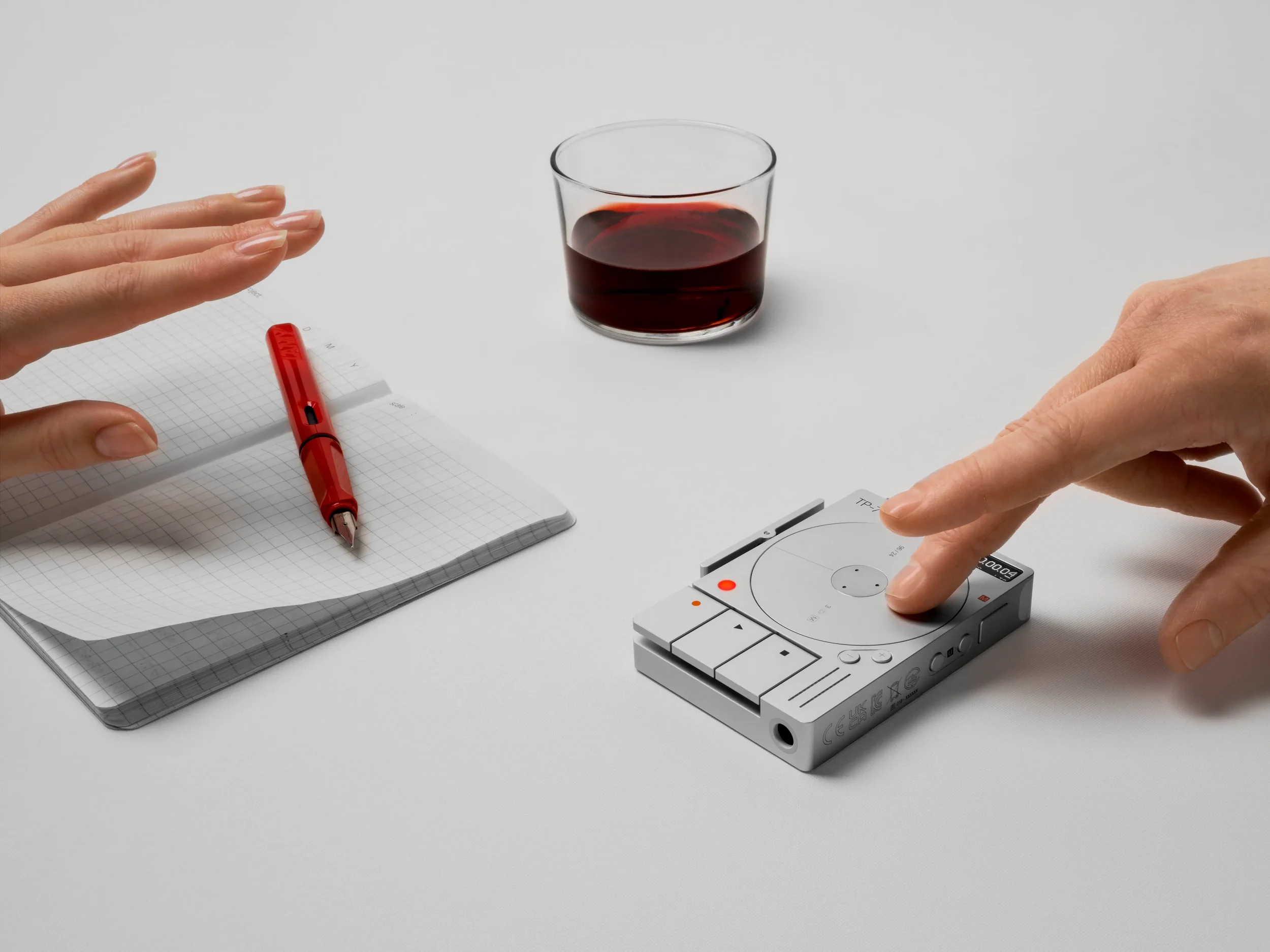
The Teenage Engineering TP-7 field recorder offers an intriguing response to that shift. At its most practical, it is a portable audio recorder designed for journalists, musicians, podcasters, and anyone who needs to capture sound. But visually and physically, it feels like something entirely different. With tactile buttons, a motorized tape reel, and a deliberately mechanical approach to interaction, the TP-7 suggests that the future of technology may involve rediscovering some of the physical qualities we spent decades removing.
Teenage Engineering has built much of its reputation around making technology feel playful. Founded in Stockholm in 2007, the Swedish electronics company has developed synthesizers, speakers, recorders, and other devices that often blur the boundary between professional equipment and beautifully designed objects. The TP-7 continues that philosophy through a miniature form.
Its most distinctive feature sits directly at its center. A motorized reel rotates as audio plays or records, immediately recalling the movement of a traditional tape machine. The resemblance is more than decorative. Users can physically stop the reel, move backward or forward through a recording, and use it to navigate audio. A side-mounted rocker provides another tactile way to scrub through recordings.
In purely technological terms, none of this is necessary.
A touchscreen could accomplish many of the same functions. A progress bar could show where you are in a recording, while digital buttons could control playback. Teenage Engineering’s decision to create physical mechanisms instead is what makes the TP-7 interesting. It transforms navigation into interaction.
That distinction matters because so much modern technology now feels physically identical. Opening a banking app requires essentially the same gesture as opening a camera. Editing a photograph feels remarkably similar to scrolling through social media. Reading a newspaper, selecting music, answering an email, and checking the weather all involve tapping and swiping across the same flat surface.
The software changes, but the physical experience rarely does.
The TP-7 reverses that relationship. Its purpose can be understood partly through touch. Buttons perform specific functions. The reel moves. Controls respond physically. Instead of asking a screen to imitate an object, Teenage Engineering has designed an object around the action it performs.
This is particularly appropriate for sound.
Audio recording has historically been an intensely physical process. Tape machines spun. Cassettes clicked into place. Mixing desks were covered with faders, knobs, switches, and meters. Recording involved manipulating equipment whose physical behavior was directly connected to what was happening to the sound.
Digital technology removed many of those limitations, but it also removed some of that physical relationship.
The TP-7 attempts to bring it back without abandoning the advantages of digital recording. Beneath its retro-inspired interaction is a decidedly modern device. It includes 128 GB of internal storage, a rechargeable battery, a built-in microphone and speaker, USB-C connectivity, Bluetooth, and multiple audio inputs and outputs. Teenage Engineering also designed it to work alongside its companion applications for functions such as transcription and file management.
That combination is important. The TP-7 is not nostalgic simply for nostalgia’s sake. It does not require tapes, sacrifice digital storage, or recreate every inconvenience associated with older recording equipment. Instead, it asks which aspects of older technology were actually enjoyable to use and brings those qualities into a contemporary device.
This approach is appearing increasingly across the technology industry.
Mechanical keyboards have returned to desks after years of increasingly thin laptop keys. Dedicated cameras have found renewed cultural relevance despite the extraordinary cameras already inside smartphones. Vinyl records continue to coexist with streaming. Physical notebooks remain popular despite countless note-taking applications.
Even automobiles have become part of the conversation, as drivers question whether frequently used controls should be hidden inside increasingly complicated touchscreens.
What connects these trends is not necessarily a rejection of digital technology. It is a desire for physical feedback.
A button confirms that something has happened. A dial communicates its position before a screen needs to explain it. A switch can sometimes be operated without even looking at it. These interactions create a small but meaningful relationship between the user and the object.
There is also an element of intentionality. Taking out a dedicated recorder communicates a different purpose than opening another application on a phone. For a journalist conducting an interview, a musician capturing an idea, or a filmmaker recording sound, the TP-7 creates a device dedicated to that single activity.
The smartphone is extraordinary, as it can do almost everything, but that versatility can also become distracting. A recording session exists inches away from incoming messages, emails, social media, and every other digital interruption competing for attention.
A dedicated object creates separation.
That philosophy resembles the renewed appeal of dedicated cameras. A photographer carrying a camera has made a small decision to take photographs. Someone carrying the TP-7 has similarly chosen to listen and record. The technology becomes connected to a specific activity rather than functioning as another window into everything at once.
Its design reinforces that sense of purpose. The TP-7 is compact enough to be held in one hand, with an aluminum construction that gives the device a distinctly engineered appearance. Nothing about it tries to resemble a smartphone. Instead, the controls are allowed to become part of its visual identity.
For years, technological progress has often been measured by how much hardware can disappear: thinner devices, fewer buttons, and more functions absorbed into a screen. The TP-7 suggests that physical interaction deserves a place in that future. Its moving reel and tactile controls bring a familiar pleasure to digital recording, making the act of capturing and navigating sound part of the device’s appeal.
The value of this approach lies in recognizing which qualities of older objects are worth carrying forward. Technology can become more capable while remaining satisfying to handle. The TP-7 makes that argument through its design: sometimes, the most compelling innovation is giving us something to touch again.