

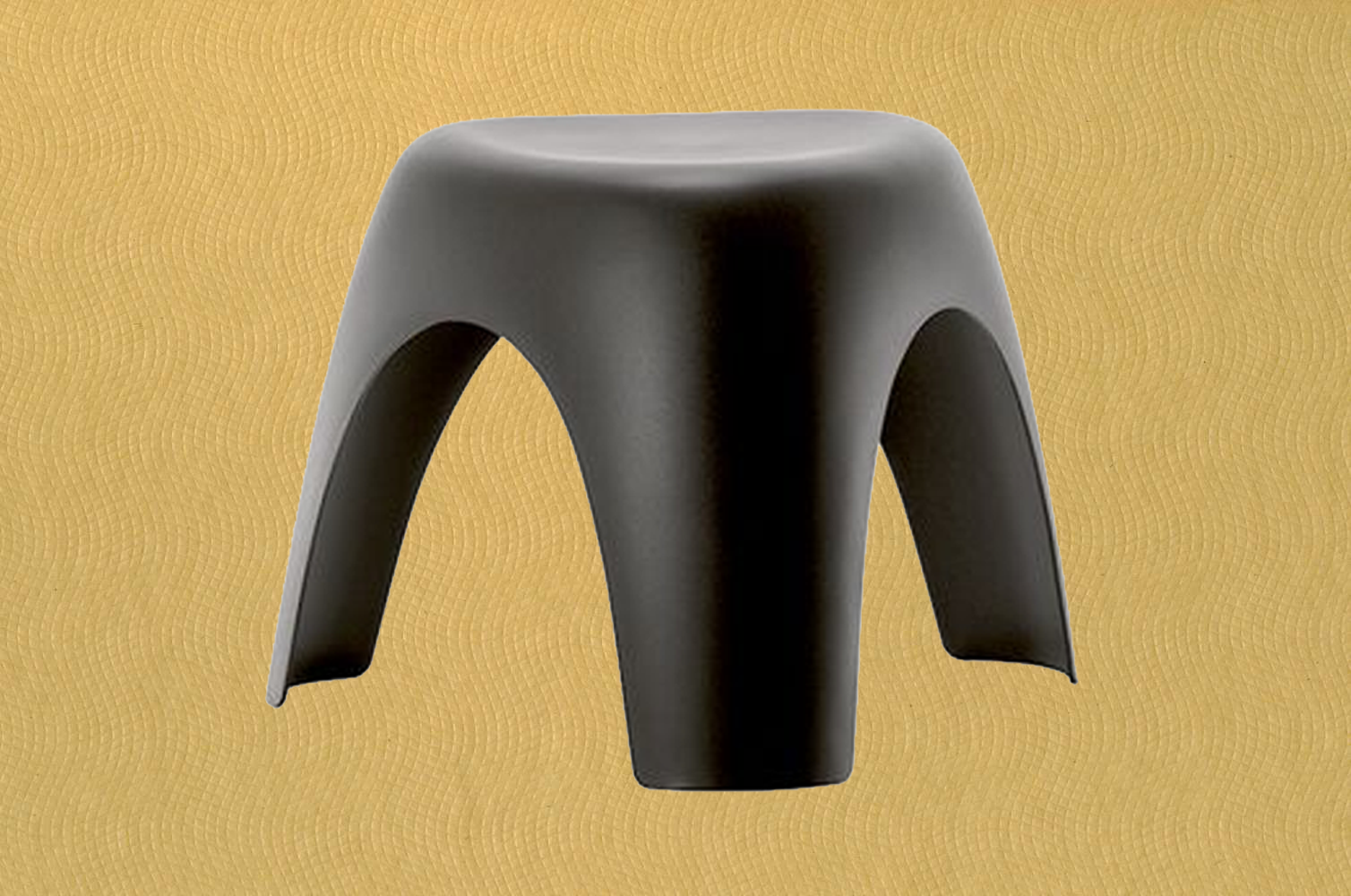
The best pieces of design rarely belong to just one stage of life. They move with us, adapting to changing homes, routines, and even generations. A chair that begins life in a child’s bedroom might later become a side table in a first apartment before finding its place in a carefully curated living room decades later. Few objects embody this quiet longevity quite like the Vitra Elephant Stool.
Originally designed in 1954 by Japanese industrial designer Sori Yanagi, the Elephant Stool has become one of the defining icons of post-war design. Its instantly recognizable silhouette, formed from two sculptural legs and a gently curved seat, takes inspiration from the sturdy stance of an elephant while remaining remarkably simple. More than seventy years after its creation, its appeal feels just as contemporary as when it first appeared.
What makes the Elephant Stool particularly compelling is its refusal to be confined to a single purpose. It functions as a stool, a side table, a plant stand, or simply as a sculptural object within a room. Lightweight yet durable, it can move effortlessly from the living room to a balcony, a children’s playroom, or even a garden. Rather than dictating how it should be used, it quietly adapts to the needs of the people who own it.
This versatility reflects a broader shift in contemporary interiors. Increasingly, homeowners are investing in fewer, better-designed pieces that can evolve alongside them. As living spaces become more flexible, furniture is expected to perform multiple roles while maintaining a timeless aesthetic. Objects are no longer purchased simply to fill a room. They are chosen because they continue to earn their place over many years.
The Elephant Stool achieves this through extraordinary simplicity. No unnecessary details are competing for attention. Every curve serves both a structural and aesthetic purpose, creating an object that feels equally at home in minimalist interiors, colourful family homes, and contemporary apartments. It is playful without feeling childish and sculptural without becoming impractical.
Part of the stool’s enduring success lies in Sori Yanagi’s design philosophy. Throughout his career, he sought to combine the precision of modern industrial production with the warmth and craftsmanship of traditional Japanese design. The result was furniture that felt intuitive rather than manufactured, objects whose beauty emerged naturally from their function. The Elephant Stool remains one of the clearest expressions of that philosophy.
There is also something refreshingly optimistic about its design. The gentle curves soften a room dominated by straight lines, while its compact proportions allow it to disappear when necessary or stand proudly as an accent piece. Available in a range of understated colors, it complements rather than competes with its surroundings, quietly contributing character to any interior.
Perhaps that explains why the Elephant Stool has remained relevant across generations. Children instinctively see it as something playful. Adults appreciate its engineering and versatility. Designers admire its proportions, while collectors recognize it as an enduring piece of twentieth-century design history. Few products manage to bridge those worlds so effortlessly.
In an age of fast furniture and rapidly changing trends, the Elephant Stool offers an alternative perspective. It reminds us that good design is not measured by novelty, but by longevity. The objects we treasure most are often those that continue to find new purpose as our lives evolve. They become part of family photographs, accompany house moves, and quietly witness the passing of time without ever feeling outdated.
Good design is often described as timeless, but perhaps a better description is adaptable. The Vitra Elephant Stool has endured, not because it refuses to change, but because it allows the people who own it to change around it. In doing so, it becomes more than just a piece of furniture. It becomes part of the story of a home.