

Aesthetic Expression: Ritual and Reclamation in the Art of Guadalupe Maravilla
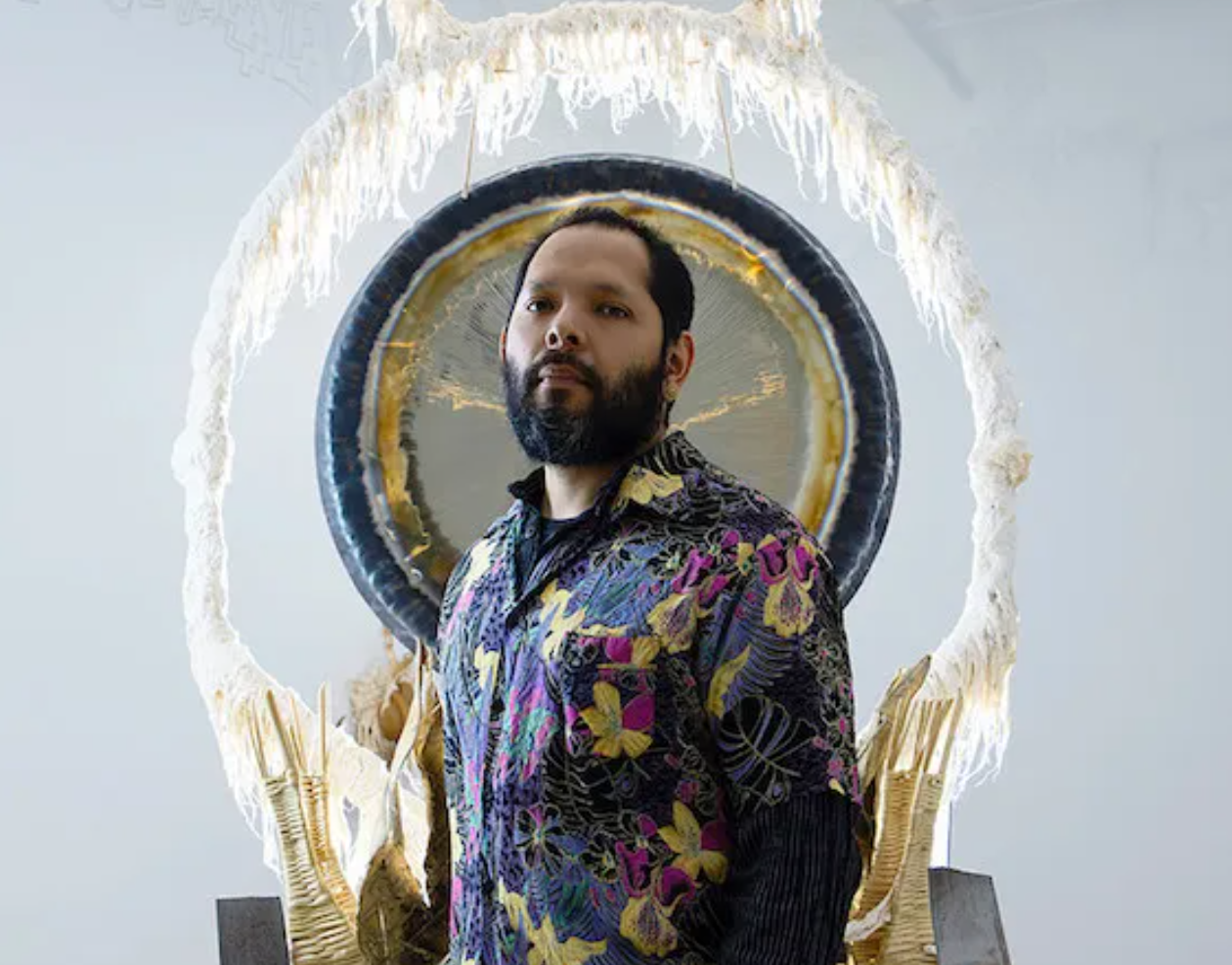
Steve Benisty/P.P.O.W. Gallery
The sound comes first. A low, reverberating hum of gongs fills the room, rippling through air and bone. The sculptures—towering amalgamations of steel, volcanic rock, conch shells, and anatomical models—seem to breathe. People sit in silence, eyes closed, as vibration turns into communion. This is not your average gallery experience. This is a healing ritual led by Guadalupe Maravilla, the El Salvador–born artist transforming museums into sanctuaries of care.
For Maravilla, art is both memory and medicine. His installations, performances, and sound baths are grounded in his own lived history, one marked by displacement, illness, and rebirth. “I’m an artist. I’m also a healer, and I combine the two,” he once told the Joan Mitchell Foundation. That fusion of art, body, and ritual defines the multisensory world he has built across spaces from the Museum of Modern Art to the Brooklyn Museum.
From Migration to Metamorphosis
Born in San Salvador in 1976, Maravilla fled El Salvador’s civil war at age eight, migrating alone to the United States in the 1980s as part of the first wave of unaccompanied Central American minors. He later became undocumented, growing up between states of invisibility and survival. Years later, after receiving U.S. citizenship and earning his MFA from Hunter College, he was diagnosed with colon cancer. It was an experience that catalyzed his transformation as both artist and healer.
For Maravilla, illness and migration are intertwined. The trauma of displacement, he has said, lived in his body long before it manifested as disease. His practice, then, became a process of expelling—not metaphorically but literally—what the world had lodged inside him. The result is a body of work that blends sculpture, sound, and ritual to reconfigure both personal and collective healing.
Mapping the Body, Redrawing the Border
Before the monumental installations came the drawings. In his early series, Maravilla reimagined the Salvadoran children’s game tripa chuca, which is a winding puzzle of lines connecting paired numbers as a form of spiritual cartography. Overlaid onto colonial maps and migration routes, these drawings trace the invisible geographies of exile: the physical crossings, the psychic ruptures, the pathways home that exist only in memory.
The body itself becomes a map in his work: a site of migration, transformation, and reclamation. This is evident in pieces like I Crossed the Border (2021), where Maravilla performs under a solar-reflective headdress while ice blocks melt beneath him, a haunting echo of ecological collapse and human endurance. The performance invokes both the cosmic and the corporeal: borders blur, and what remains is the sound of thawing, the shimmer of survival.
The Disease Thrower Sculptures
Maravilla’s signature series, Disease Thrower, takes healing to monumental proportions. Built from steel tubing, gongs, loofahs, anatomical models, volcanic stones, and objects gathered along his migration route, each sculpture functions as a kind of ceremonial instrument.
The title comes from a mistranslation of a Salvadoran healing ritual. In these works, disease is not an abstract metaphor but a material presence to be confronted, sounded out, and released. During performances, Maravilla strikes gongs mounted within the sculptures, creating deep frequencies that resonate through the bodies of participants. The result is a multisensory ceremony—half concert, half exorcism—where art becomes an agent of restoration.
“Now that I’ve learned to heal myself, I have to teach others how to heal themselves,” as said on his MoMA artist profile. The sculptures, often arranged in semicircular formation, envelop viewers in vibration. They ask not to be looked at but felt; to experience art as frequency, not as spectacle. In that shift, Maravilla reclaims the gallery as a site of communal ritual rather than passive consumption.
Tierra Blanca Joven: Healing as Homeland
In his 2022 exhibition Tierra Blanca Joven at the Brooklyn Museum, Maravilla built a “Healing Room” filled with his Disease Throwers, crystals, and seating for sound baths open to the public. The title references the volcanic ash layer left by the eruption of Ilopango in El Salvador over 1,500 years ago—a geological trauma that mirrors the cultural and personal ruptures of migration.
Through this installation, Maravilla fused myth, geology, and memory: the ash of an ancient volcano becomes the dust of displacement; the vibration of gongs becomes the pulse of renewal. In a museum world often fixated on spectacle, Tierra Blanca Joven insists on care as its own aesthetic form. The exhibition also highlights his belief that healing cannot be solitary, but can also be relational, intergenerational, and collective.
Ritual as Reclamation
To experience Maravilla’s work is to step into a ritual, one that collapses distinctions between art and medicine, the sacred and the contemporary. His use of sound is not ornamental but ontological: it restructures space, reminding us that vibration was our first language. It is a reclamation of ancestral Mesoamerican healing practices, filtered through the vocabulary of contemporary art.
Maravilla’s performances often include immigrants, cancer survivors, and community members, positioning them not as audience but as participants. The emphasis is on presence, not spectacle. In this sense, his art stages a quiet but radical resistance to the alienation often embedded in both museum spaces and modern life. The ritual becomes a method of survival, an insistence that the self, even when displaced, can become whole again.
Art, Politics, and the Body
Maravilla’s art makes clear that the body itself is political terrain. His work embodies histories of border violence, medical inequity, and erasure, but without resorting to protest banners or slogans. Instead, the critique hums at a lower frequency, embedded in the material and sonic textures of the work.
In transforming his own illness into an art of collective care, Maravilla reframes suffering as knowledge and reclamation as practice. The political becomes personal, then vibrational. His art asks not for pity but for attunement: to the histories we carry, the frequencies we emit, and the communities that sustain us.
Legacy and Continuing Resonance
Maravilla’s installations have been exhibited internationally, from the Whitney Biennial and MoMA to the ICA Miami and the Henie Onstad Kunstsenter in Norway. His work is held in the permanent collections of MoMA, the Guggenheim, and the Hirshhorn Museum, among others. Yet despite the institutional acclaim, his ethos remains rooted in accessibility: many of his sound baths are open to the public and free of charge.
In 2023, he was awarded the inaugural LACMA × Snap AR Fellowship, expanding his healing practice into augmented reality—proof that ritual can evolve without losing its ancestral core. Even as technology mediates new forms of experience, Maravilla’s focus remains steadfast: art as healing, vibration as language, community as medicine.
Guadalupe Maravilla’s work doesn’t just occupy space; it re-tunes it. His installations thrum with the residue of migration and the promise of renewal, reminding us that the aesthetic and the spiritual can coexist, that beauty can be a form of care, and that art, at its most elemental, can still heal. In a world where trauma becomes content and spirituality a commodity, Maravilla insists on sincerity; his rituals are not performances but acts of return and reclamation. When the gongs finally quiet, what remains is not silence but echo—the sound of a body remembering itself.
