

At the Table: Succession—Who Gets the Recipe?
There is a lot of bureaucracy when it comes to inheritance. From deeds to bank accounts, we have devised an impressive apparatus for making sure our possessions outlive us, but nobody has figured out how to put your father’s ability to make perfect char siu into a trust.
Culinary inheritance is inconveniently incorporeal. After decades of eating, you can instinctively recognize the silken give of steamed egg and the brittle edges of steamed reeves shad. But instinct doesn’t teach anyone how to reproduce those flavors. Eventually, someone wanders into the kitchen asking for the recipe and discovers that the supposed family archive consists only of instructions like “eyeball it,” “until it looks right,” and the unhelpful “you’ll know.”
This precarious inheritance issue is something Made With Lau sets out to solve.
Chung Sun Lau (Daddy Lau) has spent more than half a century cooking Chinese food professionally. He began cooking as a child after being separated from his parents in China, attended culinary school, worked professionally in China and the United States, ran a food cart on Wall Street, and eventually operated his own restaurant in the Bay Area.
His son Randy estimates that his father knows more than 2,000 dishes from memory, which is something of a double-edged sword. An heirloom can remain unchanged as it passes from one pair of hands to another; culinary knowledge cannot. A written recipe might preserve the inventory, but the ingredient list is the least interesting thing a seasoned cook knows.
What is harder to bequeath is judgment, the accumulation of tiny decisions that, after fifty years of repetition, no longer register to Daddy Lau as decisions at all. His beef chow fun has relatively few ingredients, yet its success depends on how the beef is cut against the grain, how wet the fresh rice noodles are, and how aggressively they can be handled before they break. The coveted wok hei is particularly inconvenient for those looking for an exact formula. It emerges from heat, speed, moisture, movement and experience conspiring at once. “Cook over high heat” may be accurate, but pedagogically, it says nothing.
Daddy Lau has performed his techniques at least ten thousand times and at this point his hands simply move. This is wonderful for the cook and disastrous for the prospective heir. The fluency that makes Daddy Lau worth learning from also makes his knowledge difficult to transmit.
Randy’s role, then, is less passive archivist than persistent translator. An engineer by training and, seemingly, by temperament, he approaches his father’s kitchen with a mildly irritating curiosity required to make instinct explain itself. When Daddy Lau peels cucumbers, Randy asks how many. When he chooses gai lan, Randy wants to know why not choy sum. A marinade that has existed happily as “enough” for several decades is now subjected to the indignity of measuring spoons.
Usually this kind of generational interrogation is the stuff of family arguments: the parent bewildered that something so obvious requires explanation, the child equally bewildered that “you can tell” is being offered as an instruction. On Made With Lau, Randy’s insistence on asking and his father’s instinct to simply “do it” force actions long surrendered to muscle memory to be slowed down and narrated. The father-son gap that so often obstructs heart-to-heart conversations and the transmission of traditions is now the instrument through which cooking can be shared.
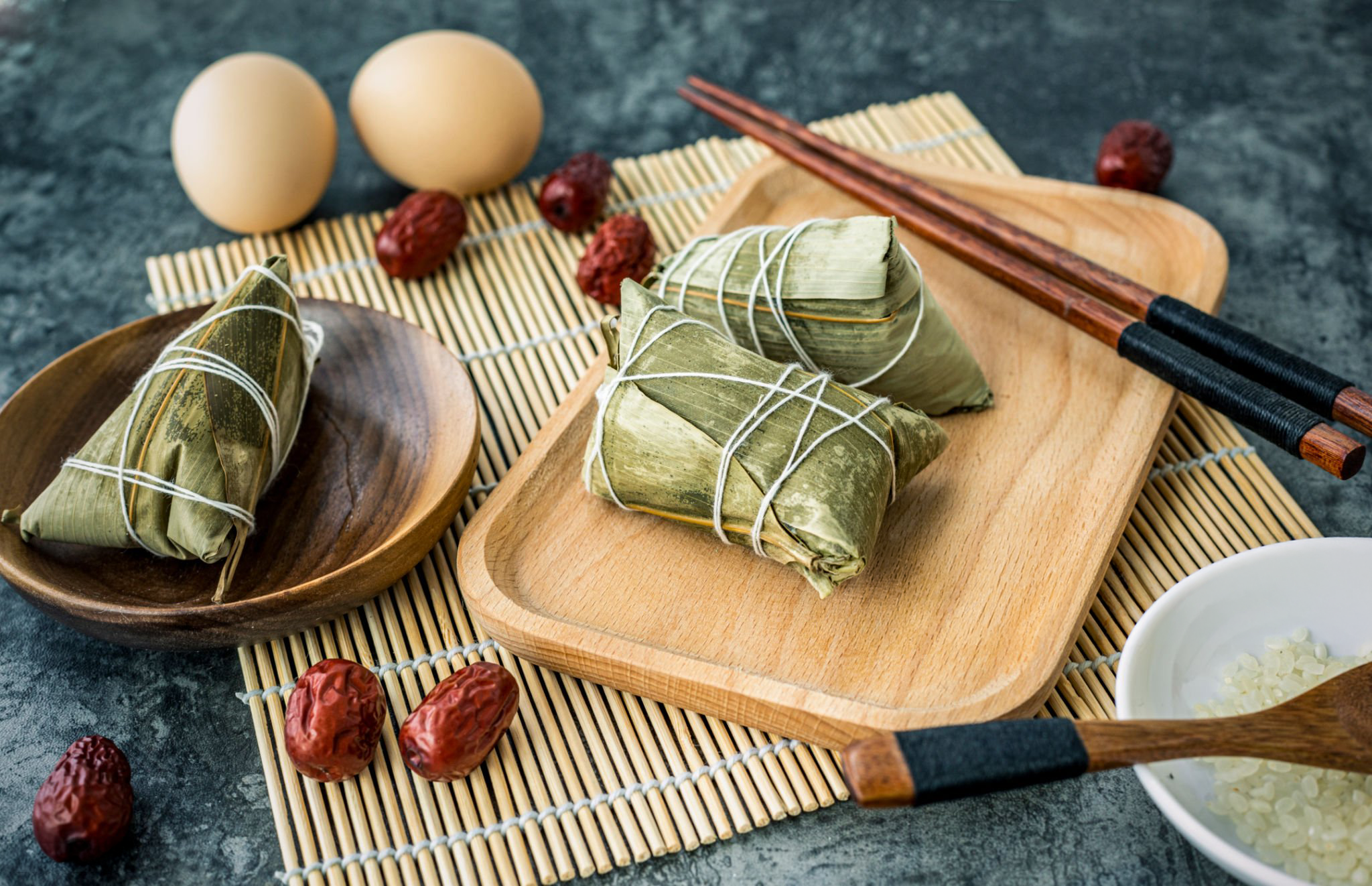
Made With Lau has many celebratory dishes one might expect from an archive of Cantonese cooking. Zongzi wrapped meticulously in bamboo leaves, roast pork with blistered crackling, whole steamed fish, and turnip cake. But some of its most revealing recipes concern dinner when nobody is celebrating anything.
There are steamed spare ribs with black bean sauce. Pork ribs are cut into small pieces, marinated with fermented black beans and aromatics, and steamed until their juices collect into a savory sauce beneath them. Or steamed chicken with mushrooms, where dried shiitakes and rehydrated wood ear lend depth to an otherwise modest plate of chicken. Or Chinese broccoli as an entry-level lesson in trimming, blanching and dressing the greens. There is no Oscar-bait equivalent here, no culinary grandstanding designed to announce heritage and diversity. These dishes are never meant to be monuments to anything. They are just things people knew how to make and, for that very reason, rarely thought to write down.
Such ordinariness complicates a familiar treatment of Chinese food online. Chinese cooking is often pulled toward opposite extremes. At one end is spectacle, filled with pleated soup dumplings, flaming woks, and banquet tables. At the other is the inexhaustible “better-than-takeout” genre, in which an enormous cuisine is filtered through the handful of dishes already legible to an American audience. Both can be entertaining, but neither is entirely innocent. Admiration can hold a cuisine at arm’s length, remarkable because it is foreign.
The Lau archive is less anxious about performing. Salt-and-pepper pork chops can sit comfortably next to ginger-scallion lobster or an ambitious roast. Recipes can be approached according to the problem dinner presents that day: something fast, something comforting, something healthier, something impressive for a date. It sounds suspiciously contemporary for a project devoted to preserving tradition, but it may be why that tradition remains useful. Made With Lau asks for no reenactment of an earlier generation’s life. Someone can learn why meat is velveted or absorb one of Daddy Lau’s habits over a twenty-minute dinner after work.
But in un-fetishizing Chinese food, has Made With Lau also made itself beholden to the machinery of the internet? The kitchen knowledge being documented is sensory, adaptive, and approximate. The internet prefers precisely the qualities it lacks. Websites want measurements and searchable titles. YouTube wants discrete steps and clickable thumbnails. Google wants a recipe it can index. A cook, who spent decades responding to the particular piece of fish or bundle of greens in front of him through intuition and repetition, must become reproducible enough that a stranger thousands of miles away can follow along.
Something is inevitably flattened in the conversion. “Until it feels right” may contain more information in Daddy Lau’s hands than “three minutes over medium-high heat” ever could. The problem is that only one of those instructions can cross an ocean without him.
Perhaps this is less a failure of Made With Lau than a limitation of preservation itself. We have not devised a digital container for instinct. To keep culinary knowledge from disappearing, the Laus must make it accessible to people who did not grow up with it. The archive inevitably participates in some of the same systems that reduce cuisines to content, but refusing those systems would hardly preserve the knowledge better if nobody could find it.
And Chinese cooking has never existed in the stasis that our obsession with “authenticity” sometimes demands. It has moved with people, encountered new ingredients and adapted itself to unfamiliar kitchens. Cantonese cooking in Guangdong, Hong Kong and California cannot exist under identical conditions, nor should it. Transmission has always involved alteration.
The immediate danger, then, is probably not that char siu or steamed fish will disappear. Restaurants can preserve the nouns of a cuisine; supermarket freezers can preserve them even longer. What is more precarious are the verbs: velveting, steaming, judging, tasting, adjusting. Knowing that beef chow fun exists is different from knowing what to do when the noodles in front of you are wetter than they were last time.
That is the compromise Made With Lau makes. It converts an inheritance that once lived in somebody’s hands into the blunt vocabulary of measurements and categories. The translation is imperfect and occasionally reductive. But until we invent a way to upload muscle memory, it may be the best apparatus we have.
